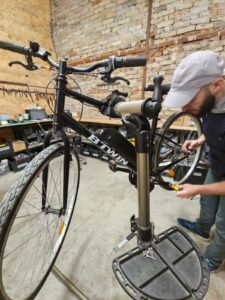
Bicycle electrification: revealing the excellence of French bicycle workshops
In a declining bicycle market, electrification is proving to be a real breath of fresh…
 Skip to main content Skip to footer
If you haven’t read the first article, I recommend you start there.
In it, I explain why speedbikes have become a ghost market in France, despite huge potential elsewhere in Europe.
In the previous article, I explained why the French speedbike market was a ghost market. Today, I’d like to tell you what I discovered while trying to create one.
Syklo has developed the PowerTrail Z8: a 1000W electrification kit that complies with the EN 15194 standard for conventional VAEs (limited to 25 km/h).
The idea naturally came to me: what if we moved up a gear?
Create a speedbike from our engine. Not some futuristic €7,000 machine that looks like a spaceship. No. A simple, robust, affordable bike. The kind of speedbike you’d want to ride every day on your 40 km commute.
My reference model? The Falkenjagd Hoplit E14: a solid steel frame, sleek aesthetics, rock-solid reliability. The kind of foundation on which you can build something lasting.
The aim: to offer a speedbike at the price of a good classic VAE, without sacrificing quality. To transform a good idea into a legally viable prototype.
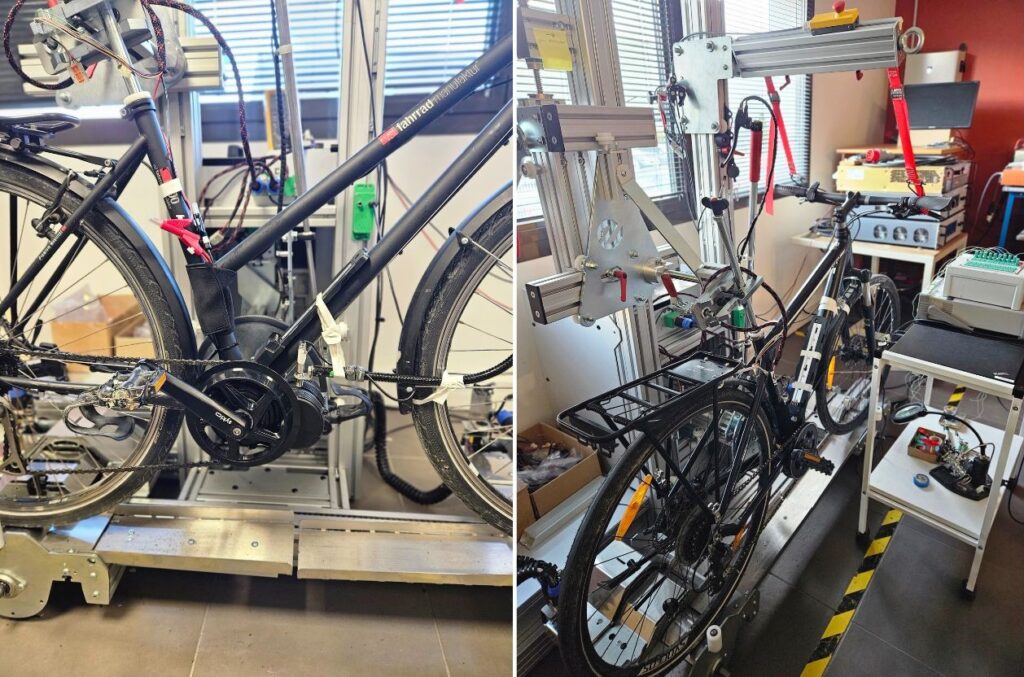
The engineer’s first reflex: break down the problem. Engine, frame, transmission, battery… How much does a speedbike really cost?
The good news: technically, it’s not that expensive.
Admittedly, supply is limited – very limited, in fact. But sourcing remains feasible for those who know where to look. Here’s the extra cost compared to a conventional VAE:
Mandatory equipment for a speedbike :
→ +100€ HT Spanninga safety devices
– ECE R113-approved front light (low-beam)
– ECE R50 rear + brake light
– License plate illumination ECE R50
– ECE R3 orange side reflectors
– ECE R28 horn
→ +100€ HT Magura M5-e adapted brakes
– Levers with anti-slip ball at end
– Cable to activate brake light when braking
– Braking power calibrated for 45 km/h
→ +50€ HT of Schwalbe ECE R75 certified tires
– Approved for use at 45 km/h
– Adapted strength and adhesion
→ +50€ HT Ergotec reinforced components
– Handlebars, stem, seatpost safety level 6
– The only ones to produce a framework B document with a detailed table of components requiring special repair/maintenance attention
Total additional cost for components: €300 excluding VAT.
Not enough to break the bank. Technically, it’s totally manageable.
First lesson: the real barrier is not industrial. It’s administrative.
This is where it gets… interesting.
A speedbike is a category L1e-B vehicle under European Regulation 168/2013. This implies full type approval. Not a simple certification as for a classic VAE. No. A full Type Approval.
First step: understand what’s required.
Reading Regulation (EU) No. 168/2013 for an electric L1e-B vehicle, we come across 31 mandatory checkpoints. My blood ran cold.
31 different tests? How much will it cost?
Fortunately, we called in a specialized engineering firm. Two, in fact, to cross-check the analyses. And then, surprise: we were able to reduce it to 18 points. Then, by optimizing for our specific technical configuration (no ABS, single-seater, certain exemptions), we’re down to 16 test points.
Here’s what the list looks like (simplified):
Mandatory tests for L1e-B :
… and so on.
Total cost of certification: €45,000
Forty-five thousand euros. For a prototype. To legally sell speedbikes in Europe.
And there’s more to come: +€5,000 per year to monitor the production conformity certificate.
Let’s be clear: this is the big sticking point.
For an SME like Syklo, aiming for 20 to 50 speedbikes a year, this means a certification cost of €900 to €2,250 per bike sold in the first year. Then another €100 to €250 per year in subsequent years.
In a market where the average selling price hovers around €5,000-6,000, this is simply prohibitive.
Type Approval is one thing. But to be able to produce and sell in series, you also need a Certificate of Production Conformity (CoP).
In theory, this means ISO 9001 certification. Quality management, traceability, documented processes, regular audits, etc.
The problem: Syklo does NOT want to embark on a full ISO 9001 process.
Why? Because we’re an agile startup of 15 people. Implementing ISO 9001 according to the rules requires human and financial resources that we don’t have. And above all, it freezes our processes – the opposite of what we’re looking for in a growth phase.
The solution: subcontract assembly to a structure that already possesses conformity certification.
A certified bicycle workshop, capable of assembling to our specifications and issuing the famous sesame. The certificate of conformity is then issued on an annual (rather than permanent) basis, allowing greater flexibility.
But here again, the devil is in the detail: recurring annual costs for small production runs (20-50 bikes/year) are very high. Between audits, follow-ups, quality controls, administrative costs… we’re easily talking about €8,000 to €12,000 a year in fixed costs.
Moral of the story: when volumes are low, the economy doesn’t hold.
Faced with this regulatory wall, there is a way out: the Luxembourg homologation office.
Why Luxembourg?
Because the two specialist engineering firms I consulted both pointed me in the same direction: Luxcontrol, the Luxembourg technical body.
Their argument? Flexibility.
Where other certification bodies apply European regulations to the letter (and sometimes even more zealously than necessary), Luxcontrol accepts technical justifications that enable significant cost savings.
In concrete terms:
As a result, costs can be halved or even more, depending on vehicle configuration.
But beware: this is a case-by-case approach. You need to put together a solid, well-argued technical file, with concrete justifications for each exemption requested.
It can be done. But it takes time, expertise, and the support of a design office that knows the ropes.
Let’s imagine we’ve cleared all these hurdles. The €45,000 is spent, the certificate is obtained, the first speedbikes go into production.
Are you all right?
No. Because then you discover the rigidity of the approved system.
Each modification = recertification.
Want to change brake supplier? Recertification.
Want to improve your lighting? Recertification.
Need to adapt frame geometry to customer feedback? Recertification.
Each time: new tests, new costs, new deadlines. Innovation is nipped in the bud.
And that’s not all. There’s also the impact on maintenance.
Bike shops – the small bicycle workshops that keep the sector alive – are not trained in the specificities of L1e-B. They don’t know the specific components. They don’t know the specific components. They don’t have the certifications. And above all, they are not covered by their insurance to work on a moped-approved vehicle.
The result? Many are reluctant to touch speedbikes. Too much responsibility, not enough volume to justify training.
The impossibility of adapting the product to real needs is therefore coupled with a faulty maintenance network.
The speedbike becomes an isolated object, cut off from the bike ecosystem.
That’s all there is to it. Now you know everything.
Building a speedbike in 2026 is not a technological problem. We know how to make powerful motors. We know how to make high-performance batteries. We know how to make sturdy frames.
It’s a regulatory compliance issue.
On volumes of 20 to 50 bikes a year, the savings simply don’t add up.
This project revealed to me a locked-in system, designed for manufacturers who produce thousands of units a year. Not for innovative SMEs that want to test the market, iterate and adapt.
It’s the dead end of an economic model designed for the 20th-century automobile, blindly applied to the soft mobility of the 21st century.
And the most absurd thing of all? Meanwhile, thousands of cobbled-together, unbridled, unlicensed electric bikes circulate freely in our cities. Unchecked. Without certification. Without traceability.
Regulation doesn’t protect anyone. It just prevents responsible players from existing.
In the next article, I’ll talk about solutions.
Because we need to rethink the regulatory framework for intermediate mobility. Create a real category for speedbikes, adapted to their reality.
And that requires political advocacy.
To be continued here:
Sources & technical references :

Rear wheel motor kit ideal for lightweight urban electric bikes
from
Price range: 790 € through 860 € TTC
4.5/5

Give your bike a second life by transforming it into
from
Price range: 600 € through 1010 € TTC
4.5/5

Discover the unique power of the TSDZ8 motor with its
from
Price range: 660 € through 1150 € TTC
4.5/5
Rear wheel motor kit ideal for lightweight urban electric bikes
from
Price range: 790 € through 860 € TTC
4.5/5
Give your bike a second life by transforming it into
from
Price range: 600 € through 1010 € TTC
4.5/5
Discover the unique power of the TSDZ8 motor with its
from
Price range: 660 € through 1150 € TTC
4.5/5