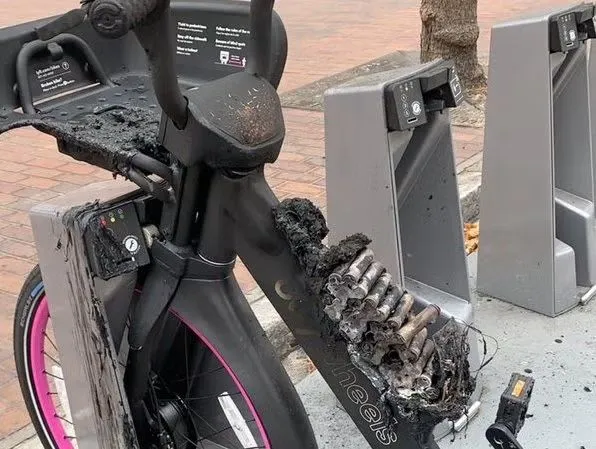
Electric bicycle battery fires regularly make the headlines. Between media hype and real risks, where does the truth lie? A major scientific study has just settled the matter: the problem lies not with electric bikes, but with low-cost electrification kits. Here's how.
E-bike battery fires are rising fast (268 fires and 18 deaths in New York in 2023), but they are concentrated in cheap batteries sold on their own and conversion kits, not in branded e-bikes.
A 2024-2025 study by the University of Warwick (WMG) for the UK government could not trigger a thermal incident on branded e-bike batteries, and found a clear link between a low price per unit of energy and poor safety.
Cause 1: incompatible components, a battery, motor and “universal” charger never tested together, so the BMS cannot protect the cells properly.
Cause 2: low-grade components, downgraded cells, a weak or missing BMS, no overcharge, overheating or short-circuit protection, no EN 62133 certification.
To limit the risk: buy battery, motor and charger as a tested system, use the original charger, never charge below 0 °C or unattended at night, and replace a battery that has been dropped, swollen or wet.
Alarming figures worldwide
Fire departments in major cities have been sounding the alarm for several years now. The figures speak for themselves:
In New York, the Fire Department (FDNY) recorded 268 lithium-ion battery-related fires in 2023, causing 18 deaths and 150 injuries. These incidents have exploded since 2020, when only 44 cases were recorded. The progression is meteoric: 104 fires in 2021, 220 in 2022, up to 268 in 2023.
In London, the London Fire Brigade recorded 48 electric-assist bike fires in 2023. The British fire department has even launched a #ChargeSafe campaign to raise awareness of the risks associated with batteries.
In Montreal, the Service de sécurité incendie documented 71 battery fires in 2024. The number has tripled in just two years, a progression described as “alarming” by Quebec authorities.
In France, recyclers report one fire a day at their processing sites. French fire departments are also reporting a spectacular rise in the number of incidents involving lithium-ion batteries.
These are worrying statistics. But are they representative of the entire electric bike fleet? The answer is no.
Swipe the table left to see all columns →
Lithium-ion battery fires: key figures quoted in this article
Place
Figure
Year
Source
New York
268 fires, 18 deaths, 150 injuries (44 fires in 2020)
2023
FDNY
London
48 e-bike fires
2023
London Fire Brigade
Montreal
71 battery fires, three times more than in 2022
2024
Service de sécurité incendie de Montréal
France
About one fire a day at recycling sites
2024
French recyclers
UK study
More than three quarters of the incidents with an identified origin came from conversion kits
2025
WMG, University of Warwick, for the UK government
The awaited British study on the subject
Given the scale of the phenomenon, in 2024 the British government commissioned an in-depth study from the Warwick Manufacturing Group, a recognized research center at the University of Warwick.
The scientists subjected dozens of batteries of all origins to extreme abuse tests in the laboratory: shocks, perforations, overloads, exposure to heat, deliberate short-circuits.
The result is clear: it’s impossible to trigger a single thermal incident on standard electric bike batteries sold in stores.
Batteries from well-known brands such as Bosch, Shimano, Yamaha and Specialized stood up to all the tests. Even when deliberately mistreated, they didn’t catch fire.
Low-cost batteries from conversion kits, on the other hand, tell a very different story. The study establishes a direct, measurable correlation: “There is a clear correlation between battery price per unit of energy and safety performance.”
More precisely, analysis of the 56% of incidents whose origin could be identified reveals that more than three-quarters came from conversion kits, and not from production electric bikes.
Why are low-cost batteries dangerous?
The Warwick study identifies two major factors explaining this difference in safety.
1. Component incompatibility
The first problem is systemic. When a consumer buys a €200 battery on AliExpress or Amazon to electrify his bike, he generally assembles :
A battery from Chinese manufacturer X
A motor from a Y manufacturer (often a Bafang BBS02 or a Tongsheng TSDZ8), bought separately from an unknown seller
A “universal” or unsuitable charger
These three elements have never been tested together. No validation of compatibility. No guarantee of integration. No standardized communication protocols.
The Warwick study is unequivocal on this point: “When an unsuitable charger is used, the risk of electrical or thermal abuse of the battery is much higher.”
The BMS (Battery Management System), the electronic circuit designed to protect the battery, can’t function properly if it doesn’t “speak” the same language as the charger and the motor. It’s like plugging a 110V appliance into 220V: sooner or later, things go wrong.
2. Poor component quality
The second problem concerns the intrinsic quality of low-end batteries. Low-cost manufacturers cut corners in order to offer rock-bottom prices:
The lithium-ion cells used are 3rd or 4th choice. Major brands such as Samsung, LG and Panasonic classify their cells by grade. The best (grade A) go to automotive or premium manufacturers. The €200 batteries are made from scrap.
The BMS is either non-existent or of mediocre quality. Yet this system is crucial: it monitors the temperature and voltage of each cell in real time, and cuts the power supply in the event of a problem. On cheap batteries, the BMS is often the first component on which savings are made.
Overload, overtemperature and short-circuit protection are absent or faulty. No thermal fuse, no automatic disconnection, no ventilation.
EN 62133 certification (European standard for lithium batteries) is simply non-existent. These batteries have not passed any official safety tests.
Michel Gentilleau, an expert at the Fédération nationale des sapeurs-pompiers de France, sums up the challenge perfectly: “The quality of lithium-ion cell assembly and proper management of the system by the BMS are crucial.”
Consequences in the field
Beyond the statistics, the human consequences are dramatic. Lithium-ion battery explosions are particularly violent and rapid.
Surveillance videos show terrifying scenarios: a battery that begins to overheat first produces smoke, then explodes within seconds with a “flaring” effect. Cells are thrown up in flames in a radius of 7 to 10 meters. The temperature quickly reaches 1000°C. The fumes contain highly toxic gases, notably hydrogen fluoride.
A London homeowner whose bike caught fire testifies, “When the bike exploded, I panicked. I thought my family was going to die.”
Faced with these risks, professionals are taking a stand. In the UK, the majority of bike shops now refuse to install batteries purchased separately online. The reason? By installing these components, they legally become manufacturers and assume full responsibility in the event of an incident.
A French mechanic tells us, “I no longer take electrification kits from unknown brands. I’m too afraid my workshop will catch fire.”
Insurers are also reacting. Some are drastically increasing their premiums, while others are simply refusing to cover claims linked to uncertified batteries. Prestigious buildings like London’s Gherkin have banned electric bikes from their premises.
What are the solutions?
The problem is primarily systemic. Thousands of low-end batteries arrive in Europe every month via platforms such as AliExpress, Amazon or eBay. Without certification. Without controls. Sometimes even without paying import VAT.
The public authorities are overwhelmed by the scale of the phenomenon. Customs cannot inspect every parcel. European safety standards exist, but there are gaps in their application to imports.
Necessary actions
Several measures are required:
Strict import standards: All e-bike lithium-ion batteries without EN 62133 or EN 50604 certification (or equivalent) are banned from entering Europe.
Systematic customs controls: introduce random tests on imported batteries, with heavy penalties for non-compliant sellers.
Compulsory certification: Make it compulsory to display the certification on all batteries sold in Europe, with a traceability system.
Complete traceability of components: Each battery should be traceable back to its manufacturer, with identification of the cells used.
The Bicycle Association UK has created a register of VAE brands audited for safety. It’s a first step, but batteries sold on their own are still excluded: it’s impossible to guarantee compatibility with the final system.
The role of consumers
Pending effective regulation, consumers have a crucial role to play. We must be prepared to pay the price of safety.
A certified battery, with quality cells and a seriously developed BMS, costs between €400 and €600. That’s 2 to 3 times more expensive than an AliExpress battery.
But the real cost of a fire is in the tens of thousands of euros: €50,000 to €100,000 in material damage, not to mention the risks to health (toxic fumes) and the lives of the occupants. Not to mention the fact that insurance companies will probably refuse to cover a claim caused by an uncertified battery.
To save €300 on a battery is to take a totally disproportionate risk.
Do Syklo batteries catch fire?
At Syklo, we’ve been committed to quality from day one. Our batteries cost a minimum of €400, or about twice as much as an AliExpress battery.
This price difference can be explained by technical and ethical choices:
Certified cells from recognized manufacturers (Samsung, LG, Panasonic), A-grade only
Intelligent, communicating BMS with real-time monitoring of temperature, voltage and current
Fuses on every cell, thanks to our laser-cut nickel plates
Laboratory tests to obtain EN 62133 certification, guaranteeing compliance with European standards
Guaranteed compatibility with our motors: battery, motor and charger are tested together before sale
Top-of-the-range chargers for safe charging without overheating
Our 150 partner workshops in France and Belgium agree to work with our products precisely for this reason: they know they can install our kits without risking their workshop and their liability.
Conclusion
Electric bike batteries don’t catch fire. Low-cost batteries from conversion kits do.
The Warwick Manufacturing Group study scientifically proves it: quality electric bicycles, sold by recognized brands, present no additional risk compared to the other electronic devices we use every day.
The problem is concentrated in a specific segment: batteries sold on their own, with no certification, no guaranteed compatibility, and assembled with mediocre quality components.
An electrified bike should give you peace of mind, not turn your apartment into a time bomb.
Faced with this situation, everyone has a responsibility: public authorities must regulate, manufacturers must make quality their priority, and consumers must accept to pay the price of safety.
Most fires come from thermal runaway in a damaged, low-grade or badly managed lithium-ion battery. The UK study by the University of Warwick points to two causes: components never tested together (battery, motor, charger) and low-quality cells and BMS in cheap batteries.
Are e-bike conversion kits more dangerous than factory e-bikes?
Cheap kits bought online are: in the UK study, more than three quarters of the incidents with an identified origin involved conversion kits. A kit whose battery, motor and charger are tested together and certified (EN 15194 for the kit, EN 62133 for the cells) does not carry that extra risk.
How can I reduce the risk of an e-bike battery fire?
Use the original charger, charge indoors between 10 and 30 °C and not unattended overnight, never charge below 0 °C, and stop using a battery that is swollen, has been dropped hard or has been in water. Buy batteries with traceable cells and a proper BMS.
What should I do if my e-bike battery starts smoking?
Get everyone out and call the fire brigade (112 in Europe). Do not try to move the battery or put it out with water if it is in flames; a lithium battery fire can reignite hours later.
Sources
Research and analysis : Personal light electric vehicle (PLEV) battery safety research : gov.uk
Fire Department of New York (FDNY) – 2023 lithium-ion battery fire statistics : CleanRider